Sunday, March 17, 2013

Regarding the Pain of Others


Susan Sontag’s Regarding the Pain of Others addressed several issues regarding the depiction of pain and suffering, with specific emphasis on war photography. She examined how war is interpreted and understood through photographs. She claimed that “one of the distinguishing features of modern life is that it supplies countless opportunities for regarding (at a distance, through the medium of photography) horrors taking place throughout the world.” She examined how the constant barrage of images desensitized the viewer to images of horror. She also discussed the role the media plays in creating an “illusion of consensus” and how the media manipulated and continues to manipulate the public.
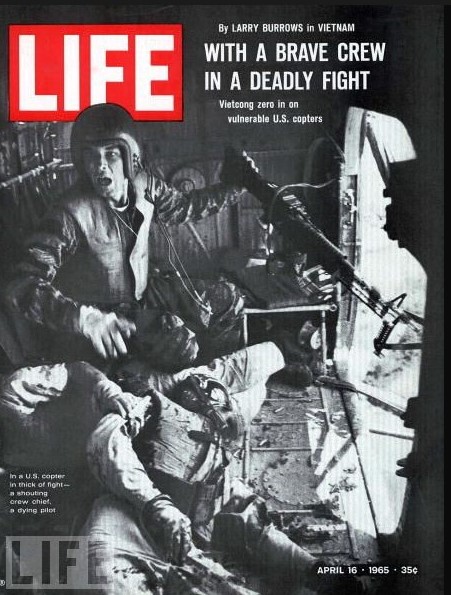
Larry Burrows, "Yankee Papa 13" 1965

Before the 1960s, the media had no desire to cover stories about Vietnam. However, by the mid- 1960s the number of press corps in South Vietnam had tripled. By August of 1964 the number had grown to 419. These journalists entered Vietnam, not with the hope of helping to end the war, but with hopes that they would capture a great story and a great shot that would be worthy enough to be shown in a high-profile newspaper or magazine.  And if they were lucky, an image they took would appear on television. The Vietnam War was also a time when war photography began to expand. Photographers like Larry Burrows and Nick Ut and their photographs became well known and Ut even received a Pulitzer Prize for his photograph of “Napalm Girl.”  These photographs displayed and exploited the suffering of others was viewed daily in American and the ethical problem of consuming images of suffering comes into play.
 

1972ut
"Napalm Girl", Nick Ut, 1972    

Vietnam did happen, and because the era's most powerful symbol of damaged ideals and the loss of trust, unity, shared myths, and common values. Like a magnet, which draws steel shavings scattered on a sheet of paper into a particular form and pattern, Vietnam gave visible shape to the great cultural changes sweeping over American society, defining, more that nay other event, the era and its pains.

Sources:

Robert Griffith and Paula Baler, Major Problems in American History Since 1945

Susan Sontag, Regarding the Pain of Others

http://en.wikipedia.org/wiki/U.S._news_media_and_the_Vietnam_War


Sunday, March 3, 2013

The October Crisis


The Cuban Missile Crisis was one the major confrontations of the Cold War. This confrontation between Cuba and the Soviet Union versus the US lasted thirteen days in October of ’62. This crisis is regarded as the closest moment in which the Cold War could’ve turned into a nuclear conflict. The October Crisis is also the first documented instance of the threat of MAD
         
Fidal Castro with Nikita Khrushchev in Moscow, 1963
Castro and Khrushchev in 1963
When Fidel Castro came into power after the Cuban Revolution, Cuba and Russia became allies. Cuba’s public allying with Russia was troubling for the US because they were concerned about the spread of Communism. The US regarded this alignment as unacceptable because of Russia’s hostility since the end of WWII. This collaboration was also in direct opposition to the Monroe Doctrine.


Kennedy and Khrushchev in Vienna, 1961.
 Even after Kennedy and Khrushchev met in Vienna in hopes of reconciliation, the hostility  of Khrushchev was too much for Kennedy, and nothing was resolved. In fact," The failure to bridge differences over key matters in Vienna made for one of the tensest summers in the Cold War."

Photo evidence of Soviet missiles in Cuba. October 14, 1962.
Talk of nuclear weapons on both sides caused major concerns and the October Crisis began after evidence confirmed that the Soviet Union was indeed harboring nuclear missiles in Cuba. Khrushchev claimed that the missiles were "solely to defend Cuba against the attack of an aggressor." After a naval blockage and a standoff, Khrushchev finally agrees to remove the missiles from Cuba.

  The threat of nuclear annihilation on both sides prevented the "mutually assured destruction" of both parties and ended one of the "most dangerous moment[s] in human history."

Sources:

Oliver Stone and Peter Kuznick, The Untold History of the United States

http://www.nuclearfiles.org/menu/key-issues/nuclear-weapons/history/cold-war/strategy/strategy-mutual-assured-destruction.htm

http://www.ourdocuments.gov/doc.php?flash=true&doc=23


Sunday, February 24, 2013

Blackboard Jungle


           After the social commentary film Blackboard Jungle was released in 1955, many Americans decided that it should be banned in theaters across America.  This film explored teenage delinquency, a topic that had been very prevalent in the ‘50s.  Blackboard jungle attracted a lot of attention, from the moment it premiered. Bosley Crowther of the New York Times wrote, “It gives a blood-curdling, nightmarish picture on monstrous disorder in a public school. And it leaves one wondering wildly whether such out-of-hand horrors can be.” Blackboard Jungle was nominated for four Oscars and had grossed $8 million dollars worldwide by 1957.

Plot:

Picture from Blackboard Jungle of Dadier and Artie
          Richard Dadier becomes a new teacher at an inner-city school known for its uncontrollable population of teenage miscreants. Upon arrival, Dadier comes to suspect Gregory Miller, a young African-American, as being the leader of these teenagers. Dadier tries many times to engage the students, while paying close attention to Miller, in hopes that if he could reach the leader, the rest would follow. However, it is later divulged that Miller is not the leader of the delinquent students,
Artie West is. In the last scene of the film Artie challenge Dadier, and Artie’s classmates have to decide whether or not to join in. One other student, affiliated with Artie’s gang lends a hand, but the rest of the class either assists Dadier or stands idly by as Artie’s reign as “head of the school” crumbles. 

“Rock Around the Clock”

Although many connect this film with the Rock-and-Roll phenomenon, the films use of rock music is minimal. The opening scene is the only part of the film that even references rock music.None of the students in the film seen to be aware of rock-n-roll.  Miller sings gospel music in a quartet and another teacher tries to introduce the students to classical music. However, the student’s anti-social behavior could be interpreted as “rock-n-roll” esque. These students were rebelling and refusing to allow adults to dictate their lives and this attitude, this abandonment of all morals is what the adults of this generation feared. “In a sense, Blackboard Jungle created the movement, others brought the tunes.”


Sources:

Jeremy Marks,http://boogiechillen.wordpress.com/%E2%80%9Coh-daddio%E2%80%9D-how-blackboard-jungle-changed-rock-roll/

Leopold, Todd “The 50-year-old song that started it all – ‘Rock Around the Clock’ made Bill Haley the first rock star” CNN ( http://www.cnn.com/2005/SHOWBIZ/Music/07/07/haley.rock) Viewed 12/16/07

“Blackboard Jungle” AFI Film Catalog (http://gateway.proquest.com/openurl…)

Crowther, Bosley “The Screen; ‘Blackboard Jungle’; Delinquency Shown in Powerful Film”
New York Times 21 March, 1955


Sunday, February 17, 2013

“For A Healthy Glow, Drink Radium!”


            While scientists were discovering and developing the atomic bomb “that would change the course of history,” the public was being introduced to one of the bombs key ingredients: radium. Many Americans and people the world over were being fed false information about Radium being a “miracle cure.” The promoters of radium claimed that it could be used for a plethora of ailments, from baldness to sexual impotence.

       Americans believed that their illnesses would be cured by inhaling or injecting radium into their bodies.

       One victim of radium was Eben Byers, a wealthy Pittsburgh native. Byers was encouraged, by his physician, to try Radithor to heal his wounded arm and because Byers believed that the radium-based liquid cured his arm he began drinking it daily. Byers claimed that the healing powers of the elixir not only cured his arm, but gave him a new sexual appetite and he began supplying the “cure” to his female friends. However, Byers’ health soon began to deteriorate and by 1931 Byers had become a victim of radium poisoning.
Newspaper article stating reason for Byers death
 Experts decided that his body was slowly decomposing. His upper jaw and most of his lower jaw were removed, and holes appeared in his skull. From there the end came quickly as he succumbed to radioactive poising.


        Other famous victims of the “harmless” element were the Radium Girls of Orange, New Jersey. (Orange, New Jersey is the same location that Bailey Laboratories was located.)These girls, like Byers, were unknowingly poisoned. In and around 1917, female factory workers were mislead into believing that the radium that they were working with was harmless. These women not only worked in an environment with radium, but also ingested large amounts of the element when licking paintbrushes covered in radium-based glow-in- the dark paint.

Female factory workers in radium dial factory (mid 1920s)


        In 1925, a New York Times article ran the headline, "New Radium Disease Found; Has Killed 5." The new disease was called, "radium necrosis," a polite term for the painful process of one's jaw disintegrating and developing tumors. The five killed by this so-called "new radium disease" were a handful of the girls who were instructed to put radium in their mouths by way of paintbrush. "Trust in radium unjustified," the article sources from a New York doctor. "Cancer called incurable." 


       Five of the factory workers filed lawsuits and although they received compensation for their trauma, all of the women died within a few short years of receiving the settlement.It was stories like Byers and the “Radium Girls” that ended the idea of radium as a “miracle cure” and led to the banning of radium in the 1960s.


Sources:

Oliver Stone and Peter Kuznick, The Untold History o the United States

Bill Kovarick and Mark Neuvil, http://66.147.244.135/~enviror4/people/radiumgirls/